
How the Shorts pool works
YouTube does not pay for a Short the way it pays for a long video. A long video earns from the ads shown on it. For Shorts, YouTube says revenue is shared on ads that are viewed between videos in the Shorts Feed, and it is shared out through a pool.
YouTube describes the monthly steps like this:
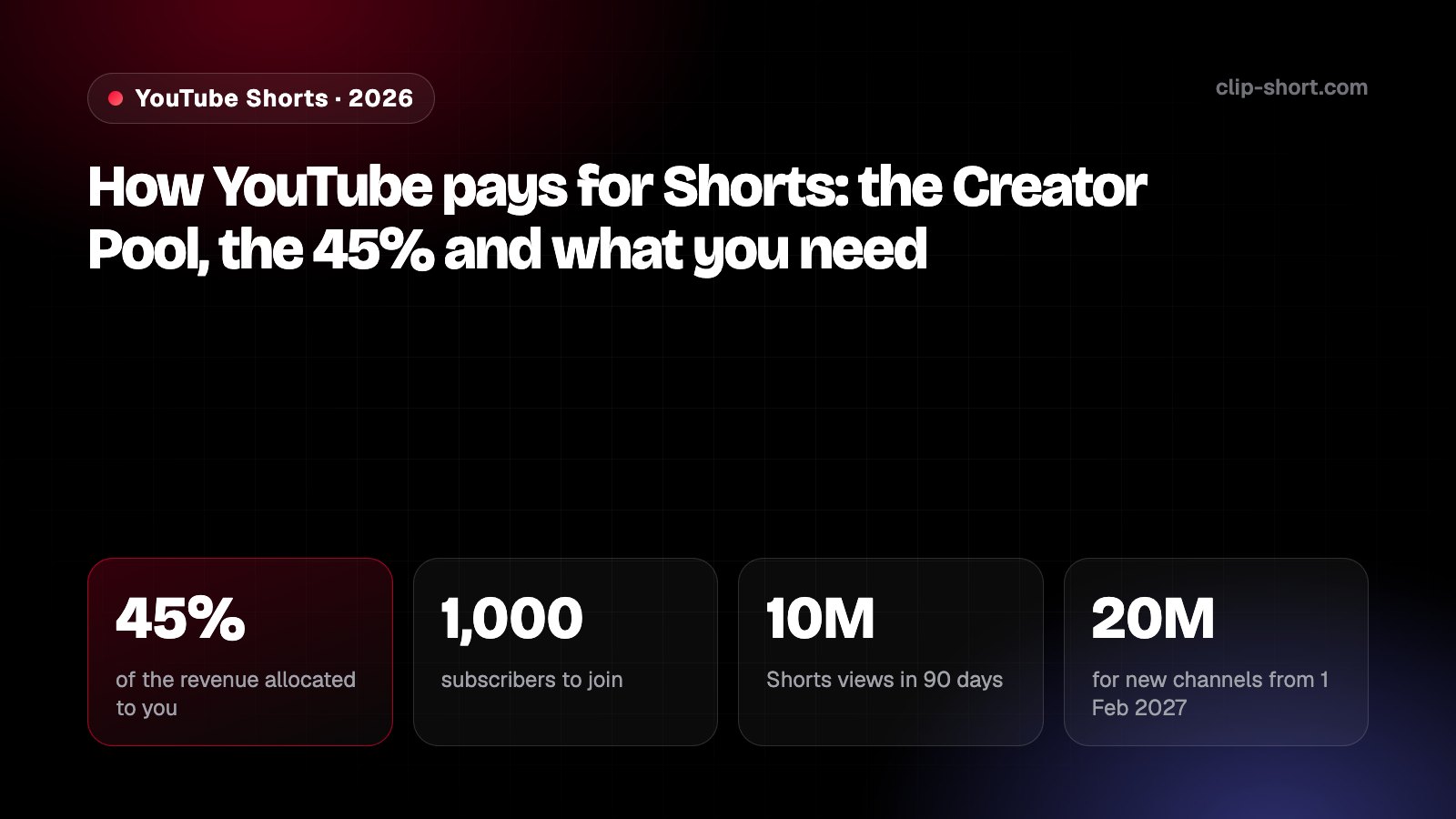
- 45%of the revenue allocated to you
- 1,000subscribers to join
- 10MShorts views in 90 days
- 20Mfor new channels from 1 Feb 2027
- Each month, the revenue from ads between videos in the Shorts Feed is added together.
- Part of it goes into the Creator Pool, based on engaged views and music use across Shorts from monetizing creators. The rest covers the cost of music licensing.
- The Creator Pool is shared out country by country, by each creator's share of the engaged views on monetizing creators' Shorts in that country. YouTube's example: a creator with 5% of those views is allocated 5% of the revenue in the pool.
- Monetizing creators keep 45% of their allocated revenue, regardless if music was used or not.
YouTube also pays 45% of the net revenue from YouTube Premium, Premium Lite included, that is allocated to monetizing creators for Shorts. To take part in any of this you must accept the Shorts Monetization Module.
What you need to join and to earn
To join the YouTube Partner Program, YouTube asks for one of these two:
Can your channel join for Shorts? Answer five questions
- Do you have at least 1,000 subscribers?
- 10M public Shorts views in the last 90 days (or 4,000 public watch hours in 12 months)?
- Do you live in a country where the programme runs?
- Is 2-Step Verification on for your Google Account?
- Is your channel free of active Community Guidelines strikes?
- 1,000 subscribers and 4,000 qualified public watch hours in the last 12 months.
- 1,000 subscribers and 10 million qualified Shorts views in the last 90 days.
- The basics for either: you live in a country where the program is available, you follow the channel monetization policies, you have no active Community Guidelines strikes, 2-Step Verification is on for your Google Account, and you link an AdSense account.
- Watch hours from Shorts views in the Shorts Feed do not count toward the 4,000 hours.
Joining is not the same as earning from Shorts. Shorts revenue also needs the Shorts Monetization Module, and from February 1, 2027 it needs 10 million qualified Shorts views in the last 90 days, as the last section explains.
Which views count
Two counts matter. Qualified Shorts views decide whether you can join or earn. Engaged views decide your share of the pool, and YouTube says it does not count engaged views that are ineligible.
Your views at your own RPM (YouTube publishes no rate)
Estimated per month
$50.00
Estimated per year
$600.00
An estimate from the numbers you enter, not a promise: YouTube decides what each view earns.
From February 1, 2027, a channel earns from Shorts only in months with at least 10 million Shorts views in the last 90 days. At these views, about 3,000,000 in 90 days, it would earn nothing from Shorts. What changes in 2027
Before Shorts pay: the YouTube Partner Program
To earn from Shorts ads a channel needs 1,000 subscribers and 10 million valid public Shorts views in the last 90 days (or 4,000 public watch hours in the last 12 months), and has to be accepted. Creators then get 45% of the Shorts ad revenue allocated to their views. From February 1, 2027, new channels need 8,000 watch hours or 20 million Shorts views to join, and a channel earns from Shorts only in months with 10 million Shorts views in the last 90 days.
Check your channel for free →| What the view is on | What YouTube says |
|---|---|
| A public Short in the Shorts Feed | Counts as a qualified Shorts view |
| A private, unlisted or deleted Short | Does not count |
| Views from ad campaigns | Do not count |
| Image Posts in the Shorts Feed | Do not count |
| Unedited clips from movies or TV, reuploads of other creators' content, compilations with nothing added | Not eligible for revenue sharing |
| Fake views, such as automated click or scroll bots | Not eligible for revenue sharing |
| Shorts that go against the advertiser-friendly content guidelines | Not eligible for revenue sharing |
When a Short features third-party content or remixed content, YouTube says the views allocated to the Short are divided between the uploader and any third-party rightsholders.
Music in Shorts and your revenue
For this, YouTube counts as music the content made available or claimed by its music industry partners, and audio made with Dream Track.
Music changes how much of a Short's revenue goes into the pool. YouTube's examples:
- No music100%
- 1 music track50%
- 2 music tracks33%
The rest pays for music licensing. Either way you keep 45% of what the pool allocates to you.
- A Short with no music: all of the revenue linked to it goes into the Creator Pool.
- A Short with 1 track: half goes into the Creator Pool, and the other half covers music licensing.
- A Short with 2 tracks: one third goes into the Creator Pool.
In every case the creator keeps 45% of the revenue allocated to them, regardless if music was used or not.
Why a Short can earn little
YouTube's pages give no rate per view and no amount for every 1,000 views. Your payment is your share of a pool, so it depends on things outside a single Short:
This is how YouTube describes the system. It says nothing about what any channel will earn, and neither do we.
- Your share is measured against all engaged views on monetizing creators' Shorts in each country, not only yours.
- Only eligible engaged views count. Non-original Shorts, fake views and views of Shorts that break the advertiser-friendly guidelines are left out.
- Music takes a part of a Short's revenue for licensing: half with 1 track, two thirds with 2 tracks.
- The ads sit between Shorts, not next to your video. YouTube says the pool is meant to reward all monetizing creators who make up the Shorts experience, not just those who have an ad next to their video.
Money is paid through AdSense for YouTube. Finalized earnings from the previous month are added to your account between the 7th and 12th of the month, and payouts come by the 21st to 26th once you reach your local payment threshold and meet the other conditions. Your estimated revenue in YouTube Analytics may change before then.
Does YouTube pay for AI Shorts?
The rules we read are about originality, not about the tool. YouTube's monetization policy asks for original and authentic content, and says content that is repetitive or mass-produced is not eligible. The Shorts page leaves out non-original Shorts. Reused content means content already on YouTube or another source with no significant original commentary or educational value added.
So a Short made with AI pictures or an AI voice is not ruled out for that reason alone. What the pages warn against is copying and mass production. To stay on the right side of it:
- Write your own idea and script for each Short, so it adds something of yours.
- Make each Short different: a new story, not the same template with a few words changed.
- Do not upload other people's clips, reuploads or compilations with nothing added.
What changes on February 1, 2027
YouTube announced these changes on August 10, 2026. They start on February 1, 2027:
- Today10M
- From 1 Feb 202720M
- 10 Aug 2026YouTube announces the new rules.
- 31 Jan 2027Last day to accept the updated terms in YouTube Studio.
- 1 Feb 2027New channels need 8,000 watch hours or 20M Shorts views. Earning from the Creator Pool needs 10M Shorts views in 90 days.
- New channels need 1,000 subscribers plus 8,000 qualified watch hours in the last 365 days, or 20 million qualified Shorts views in the last 90 days. Channels already in the program are not affected.
- To earn each month from the Shorts Creator Pool, a channel needs 10 million qualified Shorts views in the last 90 days. Below that it stays in the program and keeps other earnings, such as long-form video revenue.
- Creators below that mark can opt in to new programs: bonuses for YouTube Shopping, incentives for brand deals and earnings boosts for trends.
- When an advertiser targets a Shorts ad to five or fewer channels, eligible creators can earn a direct 45% revenue share.
- To stay active, a channel needs 1,000 qualified watch hours in the past 365 days, or 1 million qualified Shorts views in the last 90 days, or 2 long-form videos or 5 Shorts uploaded every 90 days. A channel below these gets a 90-day window to meet one.
Accept the updated terms in YouTube Studio by January 31, 2027. YouTube says creators who do not lose the related monetization features from February 1, 2027.
Before you count on Shorts income
- You have 1,000 subscribers, and either 4,000 public watch hours in 12 months or 10 million Shorts views in 90 days.
- You accepted the Shorts Monetization Module.
- Your Shorts are your own: no unedited clips, reuploads or compilations with nothing added.
- You know what the 10 million views in 90 days rule means for you from February 1, 2027.
- You read your real revenue in YouTube Studio, not a number from a video or a forum.