
Who can join
The Spotify Partner Program is for shows hosted on Spotify for Creators. A video podcast is not a requirement to apply: the program also pays ad revenue on audio episodes. Video matters for the second revenue stream, Premium video revenue, which only video episodes can earn.
These are the criteria on Spotify's help page. You must meet all of them to apply:
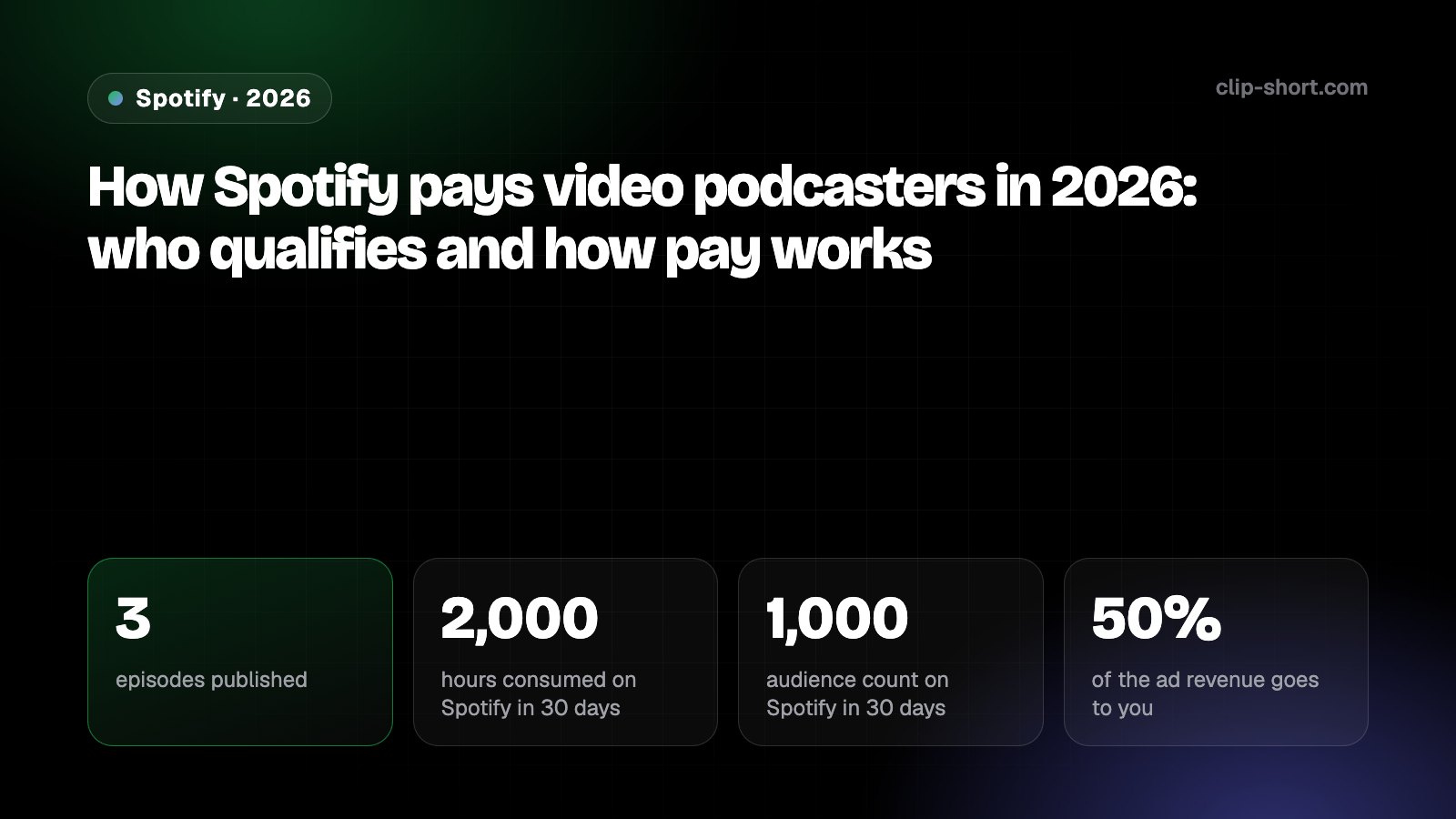
- 3episodes published
- 2,000hours consumed on Spotify in 30 days
- 1,000audience count on Spotify in 30 days
- 50%of the ad revenue goes to you
Could you apply? Answer six questions
- Is your show hosted on Spotify for Creators?
- Is your legal address in a country on Spotify's list (live now, or from 20 October 2026)?
- Have you published at least 3 episodes?
- At least 2,000 hours consumed on Spotify in the last 30 days?
- An audience count of at least 1,000 on Spotify in the last 30 days?
- Are you 18 or older and acting for a business, not as a consumer?
| Criterion | What Spotify says |
|---|---|
| Hosting | Your show is hosted on Spotify for Creators. |
| Country | Your legal address is in an eligible country (the list is below). |
| Episodes | At least 3 episodes published. |
| Hours consumed | At least 2,000 consumption hours on Spotify in the last 30 days. |
| Audience | At least 1,000 audience count on Spotify in the last 30 days. |
| Who you are | At least 18 years old, and acting for business purposes, not as a consumer (the Program Terms). |
| Review | Spotify reviews your show against the program's monetization policies. |
To stay in, Spotify says your show must, in any 6 month period, have published an episode and earned at least $10. If you pause the program for more than 6 months in a row, you may not earn enough to stay, and Spotify may remove your show.
You check where you stand on the Monetize page in Spotify for Creators, which shows your progress and the application. On 7 January 2026 Spotify announced a Distribution API that will let shows on Acast, Audioboom, Libsyn, Omny and Podigee publish video to Spotify without changing host. Spotify's help page, read on 8 October 2026, still lists hosting on Spotify for Creators as a criterion, and we found no page that says the API is live.
How pay is worked out
There are two revenue streams. Ad revenue: you earn a 50% share of the revenue Spotify recognizes every time an ad it monetizes plays in your episodes, on and off Spotify. Premium video revenue: when Spotify Premium members in select markets stream your video episodes, they watch without dynamic ads, and for those streams you earn based on how much your fans stream your show, instead of ad revenue.
Both need at least one ad break in the episode: without one, an episode earns no ad revenue and no Premium video revenue. Spotify counts a stream when someone streams your episode or video for 60 seconds or more, and uses streams to decide eligibility and revenue.
Spotify calls the formula for Premium video revenue proprietary and says it may adjust it from time to time. The factors it says the formula may use:
- 50%of the ad revenue you earn, on and off Spotify
- 1ad break needed in an episode to earn
- 60 sof streaming for Spotify to count a stream
- 100%of your own baked-in sponsorships stays with you
- the total qualifying consumption time of your eligible video episodes;
- the registration market of the Premium users who watch them;
- the unique number of Premium users with access to, or watching, an uninterrupted video experience;
- the overall amount of eligible video content that Premium users consume in those markets.
- For ad revenue you choose where the ads go: up to 5 ad breaks an episode, each with up to 5 ads, and Spotify recommends at least 15 minutes between ad breaks. You can exclude ad categories, which Spotify says may reduce what you earn.
Your own sponsorships are separate. Spotify says creators keep 100% of the revenue from sponsorships baked into their episodes. But a video with a disproportionate host-read ad or sponsorship load is not eligible for Premium video revenue.
Spotify publishes no rate per hour, per view or per episode. Its analytics show estimated ad impressions and earnings, and an ads RPM, which is what you earned per 1,000 ad impressions after the 50% split. Spotify says these are estimates, not a guarantee. Nobody can promise you an amount, and Clip-Short does not.
Which countries
Spotify's help page lists the countries where the program and Premium video revenue are available. On 8 October 2026 it listed 19 countries live now, and 37 more that open on 20 October 2026. Your legal address decides, not where your listeners are.
No Arab country is on either list: not Egypt, Saudi Arabia or the United Arab Emirates. Brazil and Mexico, with Spain, Italy, Colombia, Chile and Peru, are in the group that opens on 20 October 2026. Portugal and Argentina are on neither list.
Is your country on Spotify's list?
Spotify's list for the program and Premium video revenue, read on 8 October 2026: 19 countries live now and 37 more from 20 October 2026.
| When and where | Countries | Which ones |
|---|---|---|
| Live now: Europe | 15 | Austria, Belgium, Denmark, Finland, France, Germany, Iceland, Ireland, Liechtenstein, Luxembourg, Monaco, Netherlands, Sweden, Switzerland, United Kingdom |
| Live now: North America | 2 | Canada, United States |
| Live now: Oceania | 2 | Australia, New Zealand |
| 20 October 2026: Europe | 6 | Andorra, Italy, Malta, Poland, San Marino, Spain |
| 20 October 2026: North America | 21 | Antigua and Barbuda, Bahamas, Barbados, Belize, Costa Rica, Curaçao, Dominica, Dominican Republic, El Salvador, Grenada, Guatemala, Haiti, Honduras, Jamaica, Mexico, Nicaragua, Panama, Saint Kitts and Nevis, Saint Lucia, Saint Vincent and the Grenadines, Trinidad and Tobago |
| 20 October 2026: South America | 10 | Bolivia, Brazil, Chile, Colombia, Ecuador, Guyana, Paraguay, Peru, Suriname, Uruguay |
In some of these countries Spotify does not yet serve ads to listeners on Spotify, among them the Dominican Republic, Jamaica, Panama and Uruguay. Spotify says you can still earn for ads it delivers into your content when it is played elsewhere, and Premium video revenue.
The list is Spotify's, and it says the markets may change. The help page of 8 October 2026 gives the date 20 October 2026; the newsroom post of 17 September 2026 said only “later this fall”. A separate Spotify page lists where listeners can see Clips. That is a different list (see the Clips section).
How you get paid
Spotify pays through Spotify Payouts, and for now only to a bank account. You apply on the Monetize page and accept the Program Terms. If Spotify approves your show, it sends you to set up two-step verification and your payment details.
The steps and the waits, from Spotify's help pages:
- ApprovalSpotify asks you to set up two-step verification and your bank details in Spotify Payouts. You cannot start earning before you finish.
- 30 daysThe onboarding wait before your first payout.
- Each monthSpotify pays in the last two weeks of the month, if your balance is $10 or more after fees and taxes.
- 3 daysThe payout should reach your bank account within 3 business days of the payout date.
- Before your first payout you wait 30 days, the onboarding period. After that you are paid every calendar month, typically within the last two weeks of the month.
- You get your balance after fees and taxes if it is $10 or more. Under $10, it keeps adding up until it reaches $10.
- The payout should show in your bank account within 3 business days of the payout date. You cannot change the payment date.
- Two-step verification is required once you have earned $1,000 or more in a month. If you do not set it up within 30 days of reaching that, your payouts are put on hold, and your earnings keep adding up until you do.
- A payout fails mostly because of wrong details: name, address, tax requirements or bank details. Spotify emails you and tries again after you fix them. If your payout has not arrived after 7 business days, contact Spotify.
- You can pause the program on the Monetize page. Ads stop in episodes with ad breaks and Premium video revenue stops. It may take up to 10 business days for ads to stop on other podcast platforms.
Your monthly snapshot on the Monetize page updates in the first week of the next month, before fees and taxes. Spotify says adjustments to earnings can come after a payout and be included in later ones, and it may delay or withhold payment while it investigates invalid activity, such as bots, bought impressions or deceptive metadata.
You also give the tax information Spotify requires. Spotify does not guarantee that the program will earn you anything. The fees and taxes that apply to you are in the Spotify Payouts pages, and this guide states none.
Content rules and AI
Every show that applies is reviewed against the program's monetization policies, and must follow the Spotify Platform Rules, Monetization Policies, Advertising Policies and Promotional Content Guidelines. Spotify says its own list of examples is illustrative and may not be complete.
What Spotify's pages say, in plain terms:
- Not eligible for Premium video revenue: video whose audio is mainly non-speech noises or sounds, and video with a disproportionate host-read ad or sponsorship load.
- You cannot make content directed to children available for monetization, even if children are not its main audience (the Program Terms).
- Invalid activity can cost you the money: bots or scripts, impressions bought or induced, deceptive naming, design, formatting or metadata, and a claim by a music rightsholder through the Spotify Rights Center. Spotify can withhold payment and collect amounts it paid before.
- Spotify can end your access with 30 days' written notice, and can suspend or end it for invalid activity or a policy violation.
- Spotify says the program can change, and that it seeks to warn you of material changes 30 days ahead.
On AI-generated and reused video, Spotify's Partner Program pages say nothing specific: we found no rule that allows or bans them, and we state none. What its Platform Rules do forbid is media made with technology and passed off as true when it risks harm, and posing as another creator. Show clearly what your video is, and do not use someone else's content or music without the rights.
The pages we read give no rule on clipped video either, except that a music rightsholder's claim can hold back payment. If your show is mostly other people's material, ask Spotify before you rely on the program.
What Spotify says about Clips
Spotify Clips are short videos you upload to an episode in Spotify for Creators. Spotify describes them as a way to help people discover and engage with your show: they appear on your show page and may be recommended on Home, the Podcast feeds, Browse and Now Playing.
Spotify's pages do not say that Clips earn money by themselves. Revenue in the program comes from episode streams and ads. In its 2 January 2025 post Spotify said clips were 33% more effective than previews at turning browsers into potential listeners. Its specs for a Clip:
- 15 to 90 seconds long, at least 768 x 1024 pixels, no bigger than 1 GB, an MP4 or MOV file, with audio.
- Vertical is recommended and horizontal is supported. Captions are among Spotify's tips, for people who watch without sound.
- One Clip per episode, for a scheduled or published episode.
- Keep it about the episode: no web addresses, no calls to follow you on social media, no watermarked material from other sites, and no copyrighted music unless you own the rights.
- Listeners can see Clips on mobile in these markets: Singapore, United Arab Emirates, Albania, Ireland, Kosovo, Malta, United Kingdom, Canada, United States, Australia, New Zealand and Samoa.
A vertical clip with captions fits the tips on Spotify's page. Always check the length and the file type against the specs above before you upload.
Spotify's Clips are made by a show's own creator for that show's own episodes. Cutting moments from other people's podcasts is a different case.
What changed in 2025 and 2026
The program started in early 2025 and has widened since, to more countries and, in January 2026, to more shows. On 7 January 2026 Spotify cut all three thresholds, as the chart shows.
These are Spotify's own figures about the program, from its newsroom. They describe the whole program and its top creators, not what a typical show earns:
- Before 7 January 202610,000 h
- Since 7 January 20262,000 h
At the same time the audience count fell from 2,000 to 1,000 and the episodes from 12 to 3.
- 13 Nov 2024Spotify announces the Spotify Partner Program.
- 2 Jan 2025It opens in the United States, the United Kingdom, Canada and Australia.
- 29 Apr 2025Creators in France, Belgium, Luxembourg, the Netherlands, Ireland, New Zealand, Germany, Austria and Switzerland can enroll.
- 18 Nov 2025Sweden, Denmark, Finland and Iceland join.
- 7 Jan 2026Spotify lowers the thresholds for audience, hours consumed and episodes.
- 17 Sep 2026Spotify announces more than 35 new markets and updates the Program Terms.
- 20 Oct 202637 more countries open, among them Brazil and Mexico.
- In the first quarter of 2025 Spotify paid more than $100 million to podcast publishers and podcasters worldwide (post of 13 November 2025).
- In January 2025 payouts for creators in the program grew by over 300% compared with the year before (same post).
- Hundreds of creators earn more than $10,000 a month, and the top earners well into six figures (same post).
- Since the thresholds were lowered, total monthly payouts to enrolled shows rose by more than a third, and video shows in the program grew their consumption hours by more than 45% on average since launch (post of 17 September 2026).
Spotify's fee page says Podcast Subscriptions become Memberships on 20 October 2026, with new fees. That is a separate product for paid shows and not part of the Partner Program, so this guide does not cover it.
Before you count on Spotify income
- Your show is on Spotify for Creators and your legal address is in one of the 56 countries (19 live now, 37 from 20 October 2026).
- You have 3 episodes, 2,000 hours consumed and an audience count of 1,000 on Spotify in the last 30 days.
- Each episode you want to earn on has at least one ad break, and its sound is speech, not mostly noise.
- You know the payout steps: 30 days of onboarding, a bank account in Spotify Payouts and a balance of at least $10.