
Which platforms ask you to label AI videos
Each platform draws the line in its own place. The table puts the rules side by side, as each platform states them in its own help pages and policies.
Clip-Short's AI Agent makes videos from AI pictures and an AI voice. Whether a label is needed depends on how those pictures look and what they show, not on the tool. A clearly unreal animation or illustration is outside YouTube's rule, while TikTok and Meta ask for the label on realistic content.
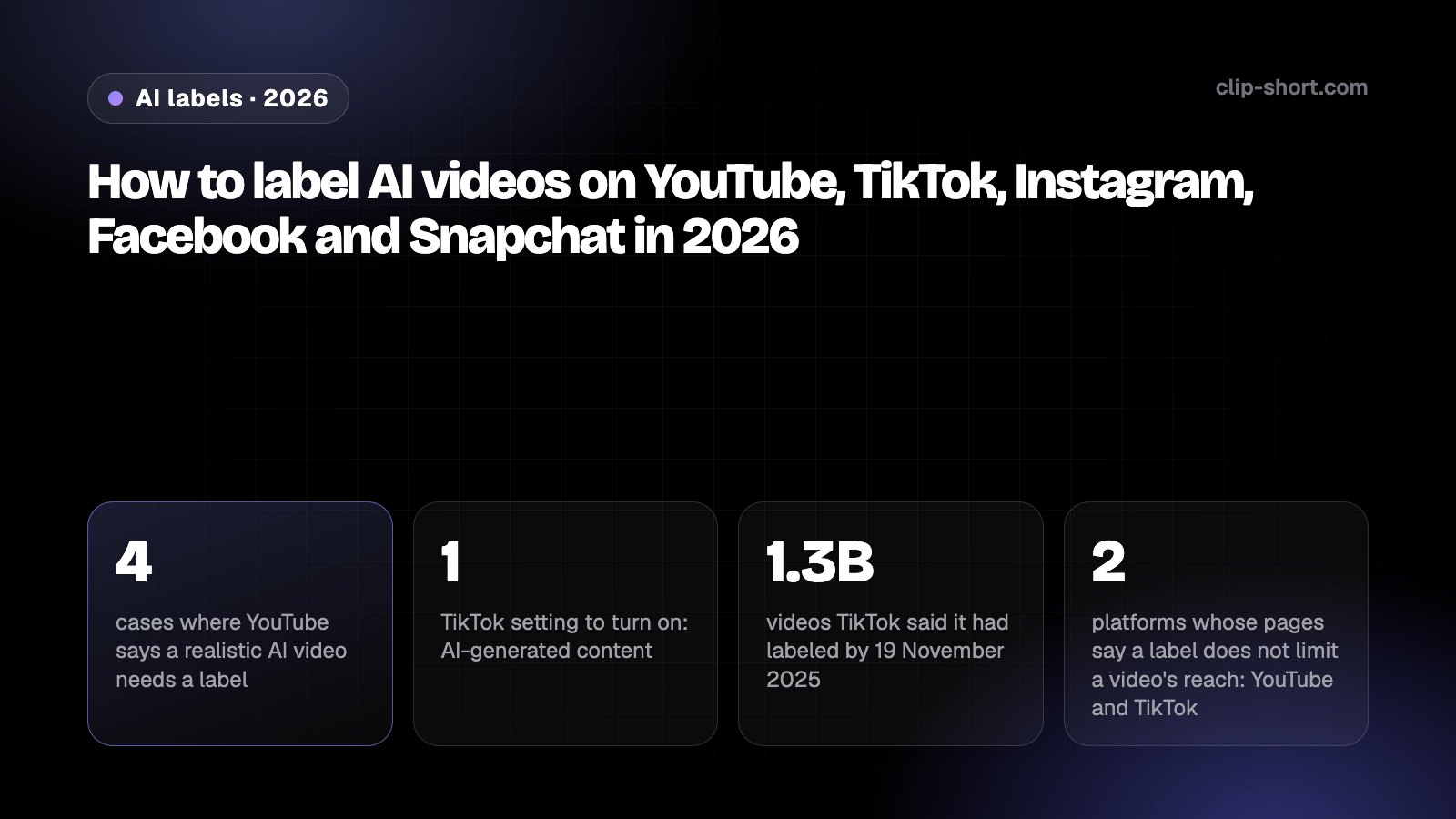
- 4cases where YouTube says a realistic AI video needs a label
- 1TikTok setting to turn on: AI-generated content
- 1.3Bvideos TikTok said it had labeled by 19 November 2025
- 2platforms whose pages say a label does not limit a video's reach: YouTube and TikTok
| Platform | When it asks for a label | How you add it |
|---|---|---|
| YouTube | Realistic content made or meaningfully altered with AI: a real person made to say or do something they did not, an altered real event or place, a realistic scene that did not happen, or music as the main focus. | YouTube Studio, Attributes, “AI use”: Yes. |
| TikTok | Required for AI-generated content with realistic images, audio or video. Encouraged for content completely generated or significantly edited with AI. | More options before you post: AI-generated content on. Or a caption, sticker or hashtag. |
| Instagram and Facebook | Required for organic posts with photorealistic video or realistic-sounding audio that was digitally created or altered. | Meta's AI-disclosure tool. The pages we read give no menu steps. |
| Snapchat | The pages we read set no label for videos made with outside tools. Some regions require labels. Monetization asks you to disclose AI use. | In the video or in your creator profile. No label switch is described. |
X has one rule of this kind: since 3 March 2026, AI-generated video of an armed conflict must carry a disclosure that it was made with AI.
Snap adds that some regions require users to label AI-generated content, and that you are responsible for your region's rules. The other platforms' pages we read do not list regions, so check the rules where you live.
YouTube: the altered or synthetic content label
YouTube's rule is about realism. Creators must disclose when they use AI to meaningfully alter or generate photorealistic content. The Help page lists four cases: it makes a real person appear to say or do something they did not do; it alters footage of a real event or place; it generates a realistic scene that did not actually occur; or it creates music that is the main focus of the video. The content can be fully or partly altered or created with AI audio, video or image tools.
YouTube says you do not need to disclose content that is not realistic, or edits that are minor, meaning mostly aesthetic and unable to mislead a viewer about what really happened.
Do I have to label this video on YouTube? Answer four questions
- Does it avoid making a real person appear to say or do something they did not say or do? (Cloning your own voice for a voice-over is fine.)
- Does it avoid altering footage of a real event or place?
- Is every realistic-looking scene in it real, and every invented scene clearly unrealistic (animation, fantasy)?
- Is AI-made music not the main focus of the video?
- Needs a label, from YouTube's examples: AI-generated music; extra AI footage of a real place, such as a surfer in Maui in a travel video; a realistic AI video of a match between two real tennis players; a realistic tornado moving toward a real city; making it look like a real person was arrested.
- No label needed, from YouTube's examples: someone riding a unicorn through a fantastical world; a fully animated video; beauty filters, colour and lighting changes; background blur; AI help with an outline, script, thumbnail, title or infographic; captions; sharpening, upscaling or repair; cloning your own voice for a voice-over or dub.
- Where to set it: YouTube Studio, on a computer or a mobile device. In the upload steps, open the Attributes section and, under “AI use”, select Yes if your content meets the requirements or No if it does not.
- The label: YouTube's blog of 18 March 2024 says it shows in the expanded description for most videos, and more prominently on the video for sensitive topics such as health, news, elections or finance. The Help page adds that a label may appear in the video player for photorealistic content.
YouTube may label a video without you. It can apply a label automatically to content made with YouTube's own GenAI tools, content with C2PA metadata, and content its systems detect as AI-generated or altered, and it sends a notice in YouTube Studio. If the system is wrong you can usually choose No, but not for YouTube's AI tools, C2PA metadata or a label added after a manual review.
If you do not disclose: YouTube says creators who consistently choose not to may get a label applied by YouTube, or penalties, including removal of content or suspension from the YouTube Partner Program.
YouTube's pages do not say whether a generic AI narrator voice needs a label. Its blog lists a synthetic voice of a real person, so a voice made to sound like a real person is a clear case for Yes.
TikTok: the AI-generated content label
TikTok says it requires creators to label AI-generated content that contains realistic images, audio and video, as its Community Guidelines explain. TikTok counts as AI-generated content any image, video or audio generated or modified by AI, including entirely AI-generated videos or images of real or fictional people, places and events, and artistic styles such as painting, cartoons and anime.
TikTok also encourages a label on content completely generated or significantly edited by AI. It calls an edit significant when the main subjects are shown doing or saying something they did not (AI-generated speech counts), or are changed so much that they are no longer recognizable, as in a face swap.
- Turn it on for a video: tap Add post, record or upload the video, tap Next, tap More options, then turn on the AI-generated content setting. For a photo, tap Post settings and turn it on.
- The label reads “creator labeled as AI-generated”. You can also say it in the post, with text, a hashtag sticker or the description.
- TikTok may add its own “AI-generated” label to content made with TikTok AI effects, or uploaded with C2PA Content Credentials. Once an auto label is on a post, you cannot remove it.
- Do not label an unaltered video: TikTok says misleadingly labeling unaltered content as AI breaks its Terms of Service and may lead to its removal.
If you do not label: TikTok says it may remove content that breaks its Community Guidelines by showing misleading information or unlabeled AI-generated content. It also prohibits some AI content even when labeled: fake authoritative sources or crisis events, false depictions of public figures in certain contexts, and the likeness of people under 18 or of private adults without permission.
TikTok says turning the setting on will not affect the distribution of your video, as long as the video does not break its Community Guidelines.
On 19 November 2025 TikTok said it was testing a control in Manage Topics that lets people choose how much AI-generated content they see in their For You feed, and adding invisible watermarks to make labels harder to strip. It said it had labeled over 1.3 billion videos.
Instagram and Facebook: the AI info label
Meta's Misinformation Community Standard says it requires people to use its AI-disclosure tool whenever they post organic content with photorealistic video or realistic-sounding audio that was digitally created or altered, and that it may apply penalties if they do not. Meta announced this in February 2024.
Meta may also add a more prominent label to digitally created or altered photorealistic images, video or realistic audio that creates a particularly high risk of materially deceiving the public on a matter of public importance. On 10 March 2026 the Oversight Board overturned Meta's decision to leave up an AI-generated video of the Israel-Iran conflict without a High Risk AI label.
- Facebook360 million
- Instagram330 million
- Threads730 thousand
Meta's own count of organic content with user label views over 29 days, each figure reported as “over”. Meta calls it a snapshot that may miss some content edited with AI.
- The label is “AI info” (called “Made with AI” until 1 July 2024). Meta adds it when it detects industry-standard AI signals, such as C2PA and IPTC data, or when people disclose that they are uploading AI-generated content.
- From September 2024, content that Meta detects as only modified or edited by AI shows the label in the post's menu. Content detected as generated by an AI tool still shows it on the post, with whether the label comes from industry signals or from self-disclosure.
- Meta keeps labeled content up unless it breaks another rule, such as its rules on voter interference, bullying or violence. The pages we read do not give the menu steps for the AI-disclosure tool on Instagram or Facebook, so check the app and Meta's Help Center.
If you do not label: Meta says it may apply penalties, and the pages we read do not say what they are. Separately, Meta says accounts that repeatedly share misinformation may get less distribution, fewer ad options or be removed. That sentence is about misinformation, not about the AI info label.
Reach and money: the pages we read do not say whether an AI label changes reach or monetization on Instagram or Facebook. Instagram's Partner Monetisation Policies ask your content to follow the Community Standards, authenticity among them, and name no AI rule.
Snapchat: disclosure and Spotlight
The Snapchat pages we read set no label switch for AI videos made with outside tools. Snap's Community Guidelines say some regions require users to clearly disclose or label AI-generated content, and that you are responsible for making your use of synthetic media meet your region's rules. Snap can act against accounts that use AI to break its rules, up to ending the account.
For its own tools, Snap adds markers: a sparkle icon, context cards, and a Snap Ghost with sparkles watermark on generated images saved to the Camera Roll. Snap tells users not to remove the watermark, and says images made with non-Snap products may not be labeled.
- Monetization: Snap's Creator Monetization Policy says content made with sophisticated editing or AI-based tools can be monetized if it is original, entertaining or informative, not misleading, and the use of AI is disclosed anywhere in the content or in the creator profile.
- Recommendation: Snap's guidelines say its ranking rewards authentic, human-made content over wholly AI-generated content made outside Snapchat, even when that content has transparency disclosures. AI content made within Snapchat is eligible, and Snap's tools always include transparency indicators.
- On 31 July 2026 Snap said wholly AI-generated videos are no longer eligible for recommendation on Spotlight. It added that no detection system is perfect, and that this is not about rejecting AI: content enhanced or edited with Snapchat's AI creative tools stays eligible.
So on Snapchat a label does not decide your reach. A video that is wholly AI-generated elsewhere is not recommended on Spotlight, even with a disclosure. Snap does not say where wholly AI-generated ends and AI-assisted begins.
Disclose anyway if you monetize: the policy asks for it. A line in your profile or in the video is enough by its words.
Does a label cost you reach or earnings?
The platforms answer differently. This is what each says on its own pages, and where it says nothing.
- YouTube says disclosing AI content does not limit a video's audience or its eligibility to earn money. Earning itself needs original, authentic content that is not mass-produced, generic or repetitive. On 15 July 2025 YouTube renamed its repetitious content policy to inauthentic content.
- TikTok says the AI-generated content setting does not affect distribution as long as the video follows its Community Guidelines. For its Creator Rewards Program TikTok asks for original, high-quality content “filmed, designed, and produced entirely by yourself”, at least one minute long. That page names no AI rule and does not say what an AI label does to rewards.
- Meta's pages we read say nothing about an AI label changing reach or earnings on Instagram or Facebook. They say only that penalties may follow if you do not disclose.
- Snap says disclosure is needed to monetize, but wholly AI-generated videos made outside Snapchat are not recommended on Spotlight, even with one.
- The pages we read publish no figure for how much reach a label costs or how much a video earns. Nobody can promise you a number, and neither can Clip-Short.
A label is not a shield either. TikTok says some AI content is prohibited even when labeled, and Meta says it removes content that breaks its Community Standards whether a person or AI made it.
When each rule started
These dates come from the platforms' own announcements. Their help pages carry no date, so a date marks an announcement, and the page may have changed since.
- 2023TikTok's synthetic media policy starts to require a label on realistic AI content.
- 19 Sep 2023TikTok launches its AI-generated content label.
- Feb 2024Meta says it will require its disclosure tool for photorealistic video and realistic audio.
- 18 Mar 2024YouTube launches its altered or synthetic content disclosure.
- 5 Apr 2024Meta announces labels instead of removal for AI media, with labeling of organic content from May 2024.
- 9 May 2024TikTok starts to read C2PA Content Credentials to label AI content automatically.
- 1 Jul 2024Meta renames “Made with AI” to “AI info”.
- 15 Jul 2025YouTube renames its repetitious content policy to inauthentic content.
- 19 Nov 2025TikTok says it is testing an AI content control in Manage Topics and adding invisible watermarks.
- 3 Mar 2026X requires a disclosure on AI-generated video of an armed conflict.
- 31 Jul 2026Snap stops recommending wholly AI-generated videos on Spotlight.
Before you post an AI video
- Do your pictures or voice look or sound real and show something that did not happen? Then turn on the label: “AI use” on YouTube, the AI-generated content setting on TikTok, Meta's AI-disclosure tool on Instagram and Facebook.
- A cartoon or a clearly unreal animation does not need the label on YouTube. TikTok and Meta ask for it on realistic content.
- On Snapchat, say in the video or in your profile that you used AI, and know that wholly AI-generated videos are not recommended on Spotlight.
- Make each video your own idea and script. YouTube and TikTok ask for original content, and a label does not replace that.