
What a micro-drama is
A micro-drama (also written microdrama) is serialized fiction made for phones. In Chinese it is duanju (短剧), "short drama". English sources also call it a short drama, a vertical drama or a mobile drama. Each episode is short, shot or drawn upright, and ends on a turn that makes you want the next one.
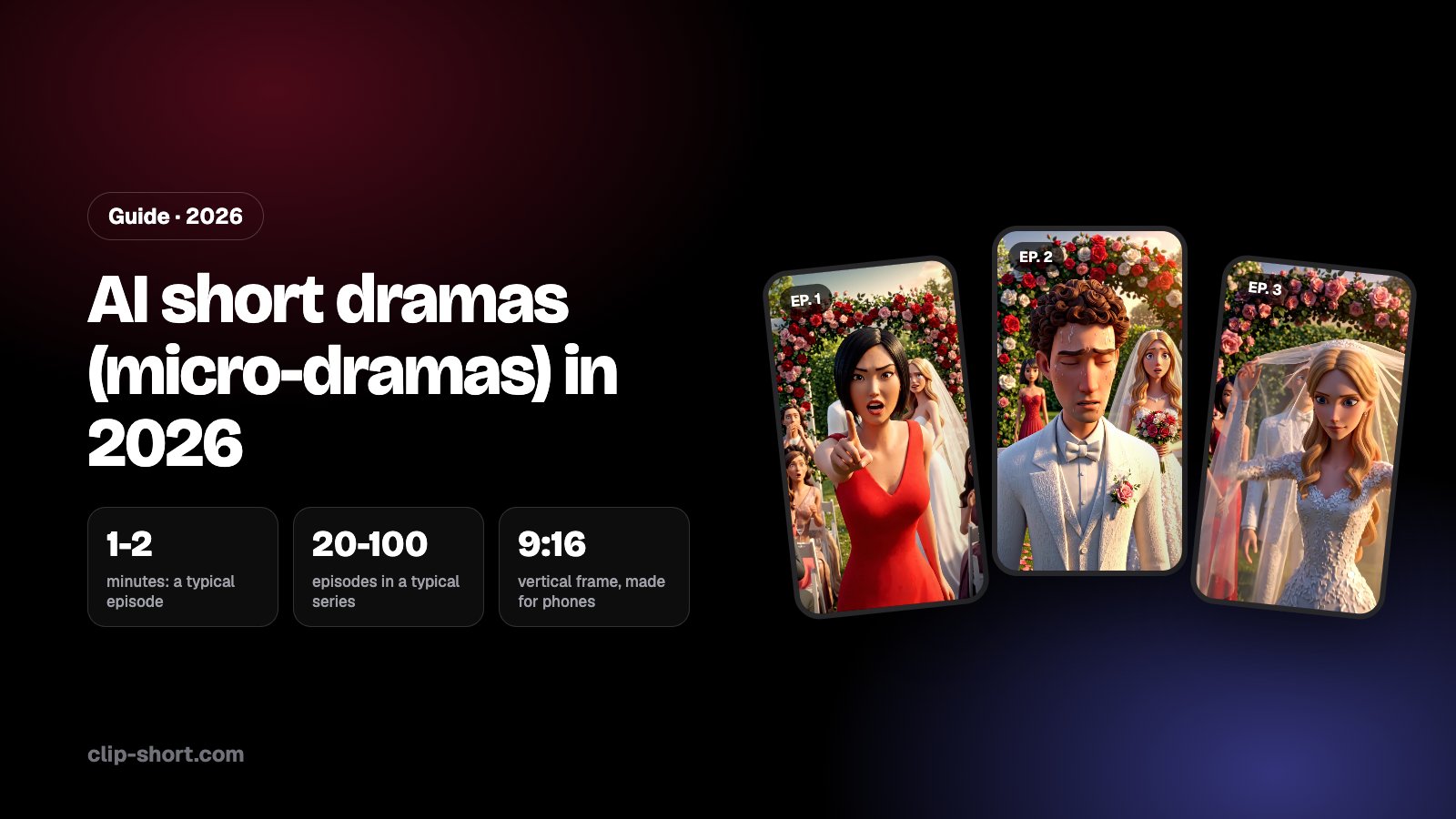
The usual format is episodes of about 1-2 minutes and 20 to 100 episodes a series, with a cliffhanger at the end of each episode, according to Wikipedia's summary of its sources. The length varies by source: a director and a founder quoted by Digital Content Next say 60-90 seconds, and the Brazilian outlet Seu Dinheiro gives about 1.5 minutes on average. "About 1-2 minutes" is the safe line.
- 1-2minutes: a typical episode
- 20-100episodes in a typical series
- 9:16vertical frame, made for phones
- 2018about when it appeared on Douyin and Kuaishou
- Pay per episode or per series (in-app purchase). Digital Content Next, quoting a founder, says the first 7-10 episodes are usually free, then about $0.50 an episode or a weekly subscription of roughly $17.
- Free with ads. Wikipedia lists three models: in-app purchase, ads and a hybrid of the two. In China the free, ad-supported model now dominates.
- Free with no ads. TikTok's own app, PineDrama, works this way (see where to post, below).
The format appeared on Douyin and Kuaishou around 2018. Kuaishou launched its "Small Theatre" section in 2019, and China's NRTA recognised duanju as a distinct genre in 2020 (Wikipedia's summary of its sources).
Three kinds of "AI short drama"
The phrase covers three different things. Keep them apart, because the numbers, the costs and the rules differ.
- Fully AI-generated. Images, video, voices and often the script come from models. In China these are called "AI comic-dramas" and "AI human-like" (photorealistic) dramas, and they make up most of the volume described below.
- AI-assisted live action. Real actors and a crew, with AI used for scripts, storyboards, effects or editing. ReelShort is mostly live action, as far as we can tell (see the questions at the end).
- AI-dubbed or localized. Live or AI footage voiced and subtitled in other languages with AI.
China's regulator calls the first group "AI micro-dramas" and has said platforms must label AI content. The Chinese statistics below count AI-generated titles, which is the first group.
The numbers, and why they differ
Market-size figures for micro-dramas are not comparable. Some count the whole industry, some only app purchases, some only the market outside China, and each is an estimate or a forecast from a different firm. Always read a figure together with its source and its scope.
For example, Omdia estimates about $11 billion in 2025 and about $14 billion in 2026, including China. Media Partners Asia (MPA) puts the market outside China at $2.7 billion in 2025. Sensor Tower counts only in-app purchases, for one quarter. All three can be right at once, because they measure different things.
- First quarter of 2025370+
- First quarter of 2026850+
Both are "more than" figures from Sensor Tower's two reports, which put the growth at 140%. Latin America was 23% of the downloads in the first quarter of 2026.
| Figure | What it measures | Source |
|---|---|---|
| About $11 billion in 2025; about $14 billion in 2026 | The whole industry, China included | Omdia, via Senal News (29 May 2026) |
| $2.7 billion in 2025; $3.6 billion in 2026 | The market outside China only | Media Partners Asia (MPA), via The Brief |
| About $1.5 billion in 2025 | The United States alone, the largest market outside China | MPA, via The Brief |
| About $700 million (first quarter of 2025); about $750 million (first quarter of 2026) | In-app purchase revenue only, one quarter, worldwide | Sensor Tower |
| More than 100 billion yuan (about $14.9 billion) in 2025 | China's micro-drama market | NRTA officials, 17 September 2026, via Global Times |
| $785 million in 2025; $1.05 billion projected for 2026 | ReelShort's revenue: MPA estimates, not company-reported | MPA, via The Brief |
Forecasts for later years are not settled either. Omdia's 2030 figure is $22 billion in Senal News and $26 billion in Seu Dinheiro, so we give neither as a fact. MPA's forecast for outside China is $9.5 billion in 2031.
China's own figures for 2025 also differ by source, date and scope, so this page uses only the NRTA's statement of 17 September 2026. The page dates of Sensor Tower's two reports are not shown. We left out figures whose scope we could not trace.
China's AI wave
China is where the format began and where AI changed it fastest. At a briefing on 17 September 2026 the NRTA (National Radio and Television Administration) said there were more than 800 million micro-drama users, that the 2025 market was above 100 billion yuan, and that 430,000 micro-dramas were released in the first 8 months of 2026, more than 90% of them AI-generated. It said 68,000 titles that broke the rules were removed in 2026 (Global Times; Momentum Works).
Earlier counts point the same way. Sixth Tone and Rest of World report about 128,000 micro-dramas in the first quarter of 2026, 95% or more of them AI. Hello China Tech counts about 470 AI dramas a day in January 2026, 14,600 for the month. AI titles were 38% of the top 100 chart that month, up from 7% a year earlier (Global Times, 7 April 2026).
Volume is not success. Hello China Tech reports that only 0.117% of 127,800 AI dramas passed 100 million views, and that the most-watched AI drama had about 1 billion views against 4.4 billion for the most-watched live-action one.
- 1 Sep 2025China's measures for labeling AI-generated and synthetic content take effect.
- Jan 2026About 470 AI dramas a day. AI titles reach 38% of the top 100 chart, up from 7% a year earlier.
- Mar 2026The Beijing Internet Court rules that unauthorised AI face swaps are unlawful, even when modified.
- 3 Apr 2026ByteDance announces a 200 million yuan fund for live-action production.
- 6 Apr 2026Hongguo penalises 670 works after auditing 15,000.
- 17 Sep 2026The NRTA reports 430,000 micro-dramas in 8 months, more than 90% AI-generated, and 68,000 removed.
- Live action still wins. In the 2026 Spring Festival period, live-action dramas were about 1 in 50 of the releases but drew 25 times the views, Sixth Tone reports. Hello China Tech puts AI dramas at about 30% of short-drama viewing in the same period.
- Handmade can be the selling point. "ENEMY", a human-made 8-episode drama with over 800 million views, went viral in China because it skipped AI, Sixth Tone reports. It also quotes a viewer saying AI dramas "feel incredibly thin".
- Platforms police copies. After auditing 15,000 works, ByteDance's Hongguo penalised 670 on 6 April 2026 for four kinds of violation: unauthorised cartoon characters, trademarks, near-copies of game characters, and actors' likenesses without permission (Global Times). Hongguo had 168 million daily active users in July 2026, up 107% on the year (QuestMobile, via KrASIA).
- Costs fell. Hello China Tech estimates an AI series at 50,000-100,000 yuan ($7,000-$14,000), against about 1 million yuan ($137,000) for live action in 2024, and a cost a minute falling from 3,000-5,000 yuan to 500-1,000 yuan. The Next Web reports production time falling from three months to one month, at about one fifth of the cost.
These cost figures are estimates, mostly from Chinese industry press, and we found no audited costs from anyone. In the West, Time reported in November 2024 that ReelShort's production cost was below $300,000 a series and took about three months, and Digital Content Next quotes $100,000-$200,000 a show for live action, with a full series shot in about 6-7 days.
The rules: China, YouTube and TikTok
Three layers of rules apply to an AI drama: the law where it is made or shown, the platform's policy on AI and on originality, and the rights of the people and brands it might copy. The first is strict in China. The second differs on every platform.
One limit first: we could not read any original NRTA rule document. Outlets describe 2026 rules for micro-dramas with different dates and different thresholds, so below we give only what the NRTA's 17 September 2026 briefing is reported to have said, and we mark the rest.
- China's labeling measures. The Measures for Labeling AI-Generated and Synthetic Content took effect on 1 September 2025. As summarised by the law firm MMLC, they require visible (explicit) labels and hidden (implicit, metadata) labels on AI-generated text, images, audio, video and virtual scenes.
- What the NRTA said about micro-dramas. On 17 September 2026 NRTA official Wang Xiaoliang said "AI is a tool; people remain the main body of creation". Platforms must label AI content and "strictly respect portrait and voice authorization and conduct full-process vetting" (Global Times).
- What we cannot confirm. Caixin Global reported on 25 June 2026 that the NRTA released draft guidelines with three tiers by investment and subject matter, a ban on content such as money worship, obscenity, gambling and discrimination, and a rule that AI-generated episodes carry clear identification labels. Other outlets describe a classification notice and management measures with other dates and thresholds. We give no tier thresholds, because the reports disagree and we could not read the originals.
- Faces and voices. Rest of World reports that platforms such as ActID (launched in March 2026) pay people about $15-$74 an episode to license their face, and that the Beijing Internet Court ruled in March 2026 that unauthorised AI face swaps are unlawful even when modified.
- YouTube, originality. Since 15 July 2025 YouTube's monetization policy has called repetitive or mass-produced content "inauthentic content". Its examples include "AI-generated content made with generic or unoriginal templates", a "highly similar storyline template across multiple videos" and slideshows with minimal narrative. That bears directly on serialized AI drama: a series that reuses one template with little variation is the stated risk.
- YouTube, disclosure. YouTube asks you to disclose realistic AI content, such as a real person made to say or do something they did not, or a realistic scene that did not happen, with the "AI use" setting in YouTube Studio. Clearly unrealistic content, such as fantasy or fully animated videos, does not need it. YouTube says disclosure does not limit a video's audience or its eligibility to earn, and consistent non-disclosure can bring a label, removal or suspension from the Partner Program.
- TikTok. TikTok requires a label on realistic AI-generated content and encourages one on content completely generated or significantly edited by AI. It reads C2PA Content Credentials to label some content on its own, and says the AI-generated content setting does not affect a video's distribution if the video follows the Community Guidelines. Its Creator Rewards page asks for original content "filmed, designed, and produced entirely by yourself" and names no AI rule, so we cannot say what an AI label does to rewards.
Characters and brands count too. Hongguo's four kinds of violation show what platforms act on: other people's cartoon characters, trademarks, game characters and actors' faces. Make your own characters, in your own look.
Platforms change these rules often and decide each case themselves. Our guide to labeling AI videos has the steps for each platform, and our AI money guide compares what each one says about earning.
Where creators can post and earn
There is no single place to sell an AI drama. Here is what exists today, and what we could not find.
- YouTube Shorts series. Announced on 23 September 2026 at Made on YouTube: creators in the YouTube Partner Program can group Shorts into seasons and episodes, with custom thumbnails and sequential playback on web, mobile and TV. It builds on the earlier Creator Shows (TechCrunch). We found no details of its revenue share.
- PineDrama. TikTok's own micro-drama app, reported by TechCrunch on 16 January 2026: free, no ads, sign in with a TikTok account, episodes of about one minute, non-union talent and low budgets, launched quietly in the US and Brazil. Brazilians downloaded it 9.1 million times in the first half of 2026 (AppMagic, via Mobile Time). We found no public program for outside creators to supply PineDrama, so do not plan on uploading there.
- TikTok Series. A paid collection of up to 80 videos, each from 30 seconds to 20 minutes, which viewers buy once at a price you choose from $0.99 to $189.99. TikTok's Series help page lists 10,000 followers (or a link to premium content you sold elsewhere), 1,000 views in 30 days and original content. TikTok's own pages have named other numbers over time, including 100,000 followers on an older terms page, so check the current page before you plan.
- The drama apps. We found no public way for an outside AI creator to supply ReelShort, DramaBox or the other apps, and no reliable pay rate for writers or creators. Be careful with any course or tool that promises a fixed pay per episode.
Our AI money guide compares what YouTube, TikTok, Facebook, Instagram, Snapchat, X and Kwai say about AI videos and earning. Our TikTok guide covers Series payments: a $50 minimum, paid on the 15th of the month, and TikTok does not say what share it keeps.
A micro-drama app earns by selling the next episode. A creator posting on a social platform earns differently: from the platform's ad share if the account qualifies, from a paid collection such as Series, or from the audience sent elsewhere. None of these has a published rate per view, so nobody can promise you an amount.
How to make an AI short drama that works
Hard evidence on what makes a micro-drama work is thin. Below, a point that rests on a named source names it; the rest is advice that how-to guides and AI-drama tools repeat, and we say so. None of it is a rule or a guarantee.
Is your AI drama episode ready to post? Answer five questions
- Is the story your own idea, not a copy of another drama or one template reused with small changes?
- If the episode looks or sounds realistic, have you labelled the AI use where the platform asks?
- Does it avoid any real person's face or voice used without that person's permission?
- Does it avoid characters, trademarks or worlds owned by a film, game or brand?
- Does the episode end on a question or a turn that makes people want the next one?
- 1
Hook in the first seconds
Many guides say to open on the jolt: a betrayal, a reveal, a threat. Some name the first 3 seconds, others the first 10. This is common advice, not a measured rule.
- 2
End every episode on a cliffhanger
Time's 2024 interview with ReelShort's founder Joey Jia calls the format "impulse purchases content": people pay for the next episode because they need to know. Digital Content Next says the first 7-10 episodes are usually free, so the hooks have to carry viewers to the paywall.
- 3
Keep the same characters, with a locked look
Keeping the same face, hair and clothes from episode to episode is the main topic of most AI-drama tutorials. Hello China Tech reports that photorealistic AI dramas showed the lowest willingness to pay among AI formats, and Sixth Tone reports viewers preferring handmade drama. In our reading, a consistent illustrated look is a safer start than copying live action.
- 4
Pick a genre with a clear promise
Wikipedia lists romance with billionaire or CEO themes, revenge, identity reveal, family drama, werewolf and fantasy among the common genres, and says the US audience skews to women aged 30-60, citing research we could not open. In Mexico, Expansion reports that parody "fruit telenovelas" are popular.
- 5
Plan the series, not just the episode
A typical series runs 20 to 100 episodes of about 1-2 minutes, so write the arc first: who wants what, what stands in the way, and what the last scene of each episode asks. YouTube's policy names a "highly similar storyline template across multiple videos", so make each episode move the story on instead of repeating one.
Time also reported that after about three months of a series, its makers get retention data "showing exactly where people drop off". Posting on a platform gives you the same kind of data: read where viewers leave, and change the next hook.
The check at the top of this section is built from the rules above. It cannot tell you whether a platform will approve or promote your video: only the platform decides that.
Latin America and the Arab world
Latin America is already a large audience. Sensor Tower puts it at 23% of micro-drama app downloads in the first quarter of 2026, behind Southeast Asia (32%) and just ahead of India (22%). Omdia, via Senal News, counts 24 million monthly active users in Brazil and 20 million in Mexico in 2025, 44 million together.
Brazil and Mexico have numbers. The Arab world has a few apps and almost no data. Read what follows with that difference in mind.
- First half of 202538.5
- First half of 202664.3
Across 8 apps, up 67%. In the first half of 2026 ReelShort had 13 million, FreeReels 11.7 million (from 0.5 million a year before) and PineDrama 9.1 million (AppMagic, via Mobile Time, 24 July 2026).
- Brazil. "Novelas verticais", "microdramas" and "novelinhas" are the terms in the press. Kuaishou, Kwai's owner, launched a free app called Sua Novela on 13 May 2025 (Tela Viva). In Brazil ReelShort charges R$42.99 a week or R$85.99 a month, and DramaBox R$459.99 a year (Mobile Time, AppMagic data).
- Mexico. AppsFlyer, via Expansion on 10 April 2026, reports microdrama app downloads up 170% on the year in Mexico, against 33% in Brazil in the same report. That 33% is not the 67% above: different providers and different periods, so do not merge them. DramaBox sells packages of $3-$25 in Mexico, and one ReelShort series can pass $20.
- Fruit telenovelas. Expansion reports that "telenovelas de frutas", stories starring unfaithful fruits, are popular in Mexico. The format echoes Fruit Love Island, an AI-generated fruit dating show that launched on TikTok on 13 March 2026, ran 28 episodes in two seasons until 28 March 2026, and is reported to have passed 300 million views before its episodes were removed from TikTok. Those view numbers come from press reports summarised by Wikipedia, which we could not open.
- Arabic apps. Seera (سيرة) is an Arabic-language vertical drama app with episodes of 60-120 seconds. Its App Store page shows version 1.0 released on 11 November 2025, $4.99 a week or $69.99 a year, and only 15 ratings. BlingWood launched in Dubai in February 2026 with 30 episodes of 2 minutes each, in languages that include Arabic, English, Hindi and Urdu, and no price announced (TBreak).
- Words in Arabic. Arabic has no settled term. App listings use "دراما قصيرة" (short drama), and "مسلسلات قصيرة" (short series) is the other phrase in use. We found no Arabic news article that picks one.
The Arabic market is early. Seera has 15 App Store ratings, BlingWood has been public for months, not years, and the Sensor Tower report we read does not break out the Middle East. We found no reliable market size, so we give none.
In our view, local-language AI drama is a gap: the stories that win in each region, such as Mexican fruit parodies or Brazilian novelas, are written for that audience. Write yours in the audience's own words, not as a translation of an English script.
Before you post an AI drama
- The story is your own idea, and each episode moves it on instead of repeating one template.
- Realistic AI scenes or voices are labelled where YouTube or TikTok asks (and where China's labeling measures apply).
- No real person's face or voice is used without permission, and no characters are owned by a film, game or brand.
- Episode one opens on a hook in the first seconds, and every episode ends on a question.
- You expect no promised result: no platform publishes a rate per view, and 0.117% of AI dramas in China passed 100 million views.