
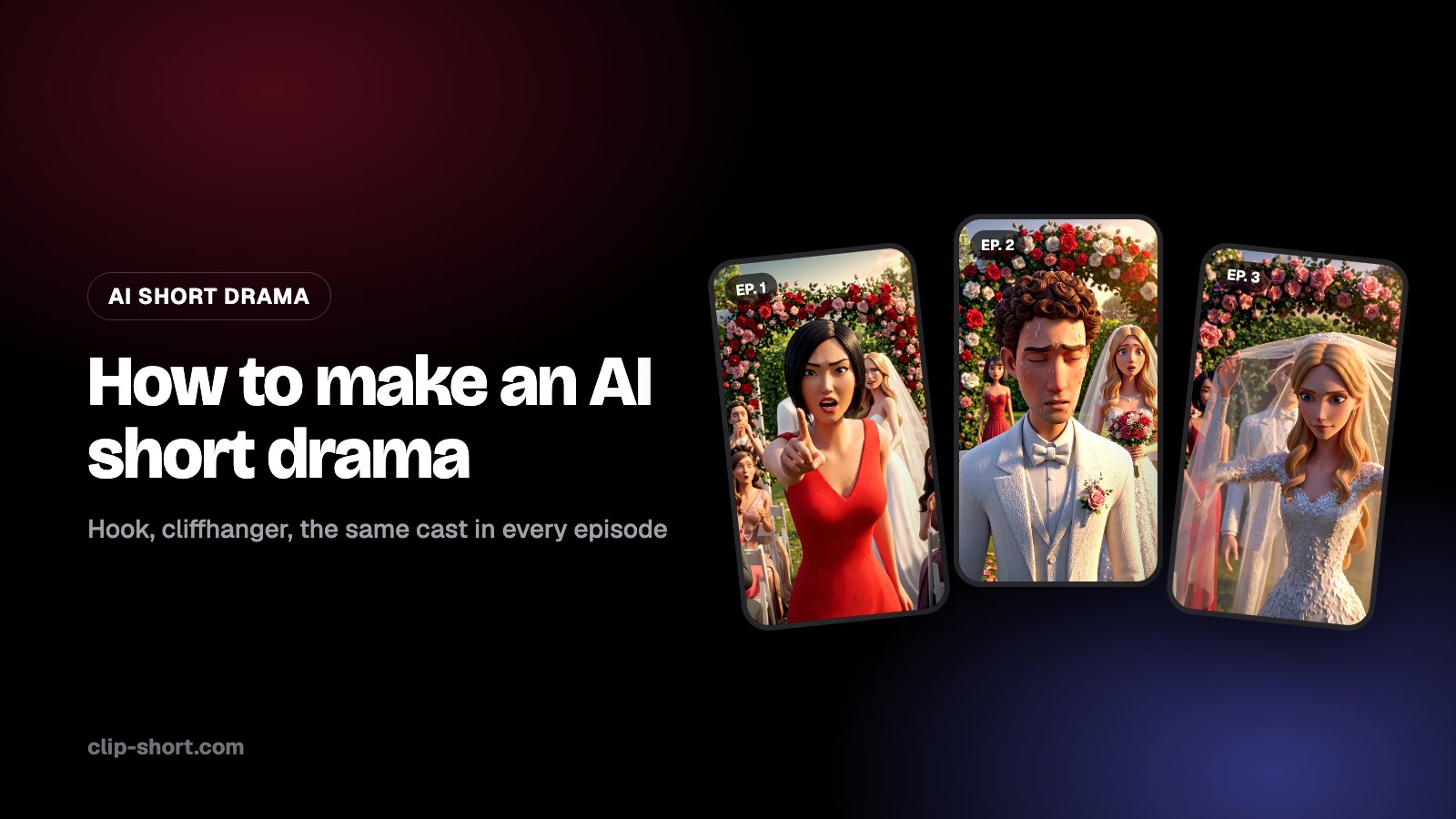
How to Make an AI Short Drama: Episodes, Hooks, Cliffhangers and a Cast That Stays the Same
Make an AI short drama series step by step: the premise, a cast that keeps its look, 1-2 minute episodes that open on a hook and end on a cliffhanger.
Short dramas are the vertical soap operas of the phone: episodes of a minute or two, a story told across dozens of them, and a cliffhanger at the end of every one so you tap the next. In China they are called duanju; in English you will see micro-dramas, vertical dramas and short dramas. The apps that sell them grew fast: Sensor Tower counted more than 850 million downloads of short-drama apps in the first quarter of 2026 alone, with Latin America making up 23% of them.
AI changed who can make one. China's broadcasting regulator said in September 2026 that 430,000 micro-dramas were released in the first eight months of the year, and that more than nine in ten were AI-generated. You no longer need a set, actors and a crew to tell a serialized story. You need a premise, a cast you can keep the same, and the discipline to end every episode on a question.
In short: write one premise with a secret at its heart, draw your cast once and describe them the same way every time, make each episode 1 to 2 minutes, open on the conflict and cut before the answer, plan the big reveals across the season, and label realistic AI footage when you post it.
For the market numbers, the rules in each country and on each platform, and how creators earn from them, read our full guide to AI short dramas.
Step 1: one premise with a secret
Every short drama runs on a secret that the audience knows, or suspects, before the characters do. The groom is already married. The delivery driver is the missing heir. The maid who was fired now owns the hotel. Write your premise as one sentence with three parts: who, what they want, and what is hidden from them.
The genres that keep coming back are revenge, a secret identity, family drama and romance, and in Mexico and Brazil, telenovelas played by fruit and animals. Pick one and stay in it for the whole season: a revenge story that turns into a romance halfway through loses the people who came for the revenge.
Step 2: a cast that keeps its look
The first thing viewers notice in an AI drama is a face that changes between episodes. Decide your cast before you make anything, and keep it small: two or three people carry most short dramas.
Describe each character the same way every time: hair, clothes, age, one detail that never changes (a red dress, a scar, a pair of glasses). In Clip-Short you draw a character once, and every picture that names them is made from that portrait, so the same face, hair and clothes come back in every episode. A character can start from a description, a drawing or a pet.
Two rules keep you out of trouble: no real person's face or voice without their permission, and no characters that belong to a film, a game or a brand.
Step 3: episodes of a minute or two
Most short dramas run about 1 to 2 minutes an episode. That is long enough for a scene with a turn in it, and short enough that the next episode is one tap away. Use the planner below to see where the beats fall at 60, 90 or 120 seconds.
One episode
Where the beats of an episode fall
- Hook0-7 sOpen on the moment: a slap, a secret, an accusation. No set-up.
- Friction7-50 sTwo people want opposite things. Every line pushes it further.
- Spike50-79 sThe turn: a reveal, a lie caught, a new person walks in.
- Cliffhanger79-90 sStop on a question. Cut before the answer.
The common pattern, not a rule: move the turn earlier when the scene is fast, and always cut before the answer.
The hook is not an introduction. Open on the moment: someone stands up at a wedding, a slap, a letter read aloud. The friction is two people who want opposite things. The spike is the turn. And the cliffhanger stops on a question and cuts before the answer.
Step 4: plan the season before episode 1
A short drama is a run of small questions with a few big answers. Decide where the big reveals go before you write the first episode, then make sure every other episode still ends on a smaller question.
One season
Plan the big reveals before episode 1
Episode 1 opens on the hook. Big reveals land in episodes 5, 10, 15, 20; every other episode still ends on a smaller question.
Step 5: make the episodes
There are two ways to make the episodes in Clip-Short, and they work together:
- A series of narrated episodes. A Series drafts each episode as a narrated video: the AI writes the script, draws the pictures with your cast, adds the voice, captions and music. Each episode can pick up where the last one ended and close on a hook, and opens with a title card that names the series and the episode. Series run on a schedule or whenever you ask, and the next ideas are written ahead so you can change them before anything is made.
- Animated scenes for the lines everyone waits for. A scene is one 8-second animated shot with its own sound, where a character says up to two short lines out loud: "Stop! He is already married." Use them for the moments a narrator should not tell.
Narration comes in 19 languages, including Egyptian Arabic, so the same drama can reach viewers in Spanish, Portuguese or Arabic. Series, characters and scenes are Pro features; on the free plan you can make a first episode as a narrated story video.
Step 6: post, and label what needs a label
YouTube, TikTok, Instagram and Facebook ask you to label AI content that looks real: a realistic person saying something they did not say, or a realistic scene that did not happen. A clearly animated drama is treated differently from a photorealistic one, and each platform words it its own way: our guide on how to label AI videos has their rules.
YouTube also warns against content made from one template with a few words changed. A drama series is fine; a channel of near-identical episodes is not. Write each episode's idea yourself.
Before you post an episode
0 of 6Questions
How long should an AI short drama episode be? About 1 to 2 minutes is the common length. Long enough for a turn, short enough that people tap the next one.
How many episodes should a season have? Short drama apps run dozens of episodes a series. For a channel you post yourself, start with a short season you can finish, plan the reveals, and make more if people come back for it.
Can AI characters look the same in every episode? Yes, if you draw them once and describe them the same way every time. Small differences can still appear, so keep each character's one unmistakable detail.
Do I need to label an AI drama? If it looks real, yes, on most platforms. A clearly animated or cartoon drama is usually treated differently. Check each platform's rules before you post.
Is it free? On the free plan you can make a narrated story video. Series, characters and scenes are Pro features.
Make your AI short drama
A series of narrated episodes with the same cast, a title card on each, and short animated scenes for the lines everyone waits for.
More you can make
Free AI video generator
What the free plan includes: an AI video every month, no card.
OpenAI story videos
Write a story idea; get a narrated video with pictures and captions.
OpenAnimated scenes with sound
Describe one moment and get an 8-second animated scene with its own sound and voices.
OpenHook titles, stickers and zooms
The AI adds a hook, stickers and punch-in zooms to a clip from what it says.
OpenCut silences and filler words
Remove the long pauses and the ums from a clip in one click.
OpenSubtitle files (SRT, VTT)
Download the subtitles of a video as an SRT, VTT or text file.
OpenTry it on your own video
Start on the free plan, and upgrade only when you need more.